AI data centers generate much more heat than traditional server rooms because of their high rack density and constant computing workloads. To make the equipment reliable and minimize energy consumption, however, a good cooling capability is needed. Aisle containment is designed to maximize the airflow, it separates hot and cold airflow streams, and aluminum extrusion profiles are both strong and flexible with precision control to ensure lifelong containment.
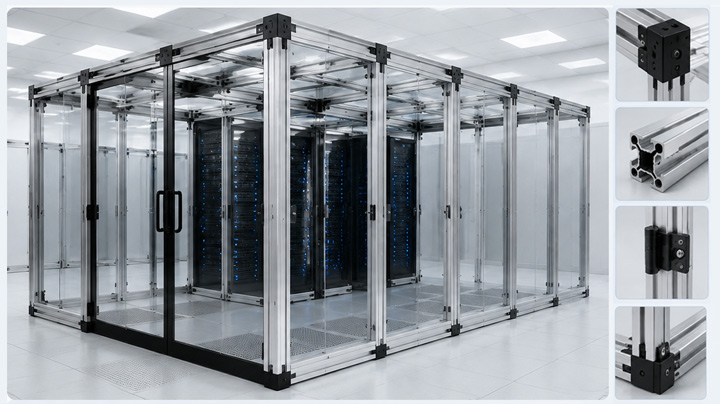
What Is Aisle Containment?
Aisle containment is one method of preventing the cold supply air and warm exhaust air from mixing in the data center. Containment Systems can consist of enclosed paths through and into server racks, directing airflow modules under control instead of mixing both airstreams.
This separation facilitates good thermal performance, reduces energy loss, and ensures even temperatures at IT equipment inlets. Data centers continue to drive the advancement of data center power density, with aisle containment as a standard feature these days.
There are two primary containment methods: hot aisle containment or cold aisle containment.
Hot Aisle Containment
Hot aisle containment (HAC) is a method that uses containment to enclose the aisle where servers send hot air. The containment system prevents hot exhaust air from dispersing across the room and recirculates it back to the cooling equipment.
With this method, hot and cold air are separated entirely, enhancing cooling efficiency and enabling higher rack power densities.
-
Configuration of Hot Aisle Containment
In a hot aisle containment configuration, server racks open up to the front and the back to the hot aisle. Aisles are closed at both ends with doors, and the roof is closed with roof panels to keep hot air from escaping to the surrounding area.
This hot air is captured inside the enclosure and directly returned to computer room air handlers (CRAHs), computer room air conditioners (CRACs), or overhead return ductwork.
-
Application of Hot Aisle Containment
Hot aisle containment is commonly used in:
- AI and GPU computing clusters
- Hyperscale data centers
- High-density server rooms
- Colocation facilities
- Data centers with high-end cooling facilities
It is especially effective at high rack densities (above 15-20kW) and in situations where accurate thermal control is needed.
Cold Aisle Containment
Cold aisle containment (CAC) is a containment method that surrounds the aisle where cooled supply air is delivered to the front of server racks. This approach prevents hot exhaust air from reaching equipment by protecting the cold air.
Mixing between supply and return air can be reduced, which allows cooling units to function more efficiently.
-
Configuration of Cold Aisle Containment
The server racks are opposite each other and define a cold aisle between the racks. Both ends of the aisle are closed by doors, and roof panels keep conditioned air in the enclosure.
The cold air coming from a raised floor or overhead supply stays within the aisle and is drawn through the equipment. After leaving the racks, the heated exhaust air goes into the open room before being recirculated to the cooling system.
-
Application of Cold Aisle Containment
Cold aisle containment is commonly used in:
- Current Data Center Upgrades
- Medium-density server rooms
- Enterprise IT facilities
- Raised-floor cooling environments
- Data centers are looking for energy efficiency with minimal impact on infrastructure.
Unlike hot aisle containment, it can be easier to retrofit into existing facilities.
Hot Aisle vs Cold Aisle Containment
| Besonderheit | Hot Aisle Containment | Cold Aisle Containment |
| Enclosed Area | Hot exhaust aisle | Cold supply aisle |
| Air Contained | Hot return air | Conditioned supply air |
| Cooling Efficiency | Very high | Hoch |
| Best For | High-density AI workloads | Existing enterprise data centers |
| Retrofit Difficulty | Moderate | Easier |
| Typical Rack Density | High to very high | Low to medium-high |
Data‑center projects frequently require aluminum extrusions that must meet specific dimensional, installation and structural performance requirements. Custom extrusion processes enable manufacturers to develop profiles compatible with diverse enclosure layouts, rack configurations and mounting specifications.
As a custom aluminum‑extrusion manufacturer, Wellste delivers aluminum‑profile solutions for industrial applications. Its product portfolio covers protective frames, equipment structures and modular systems built for data‑center deployments.
Core System Components of Aisle Containment
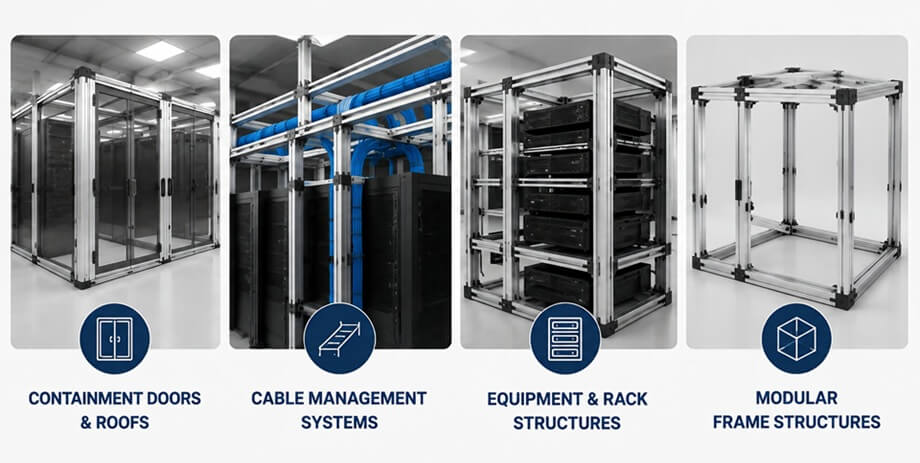
An aisle containment system is a combination of different components that ensures the hot and cold air remain separated and that maintenance and future expansion are easily accessible. Aluminum extrusion profiles are mostly used as the structural framework, as they offer strength, dimensional precision, and modular construction.
-
Structural Frame
The containment system is based on the frame. It can be used to support roof panels, doors, cable management systems, and sealing components to ensure alignment across multiple server rows. Aluminum extrusion profiles are popular due to their weight reduction, corrosion resistance, and versatility in adapting to various aisle configurations.
-
Roof Panels
The top of the aisle is enclosed by roof panels, which prevent hot and cold air from mixing. Panels are constructed from tempered glass, polycarbonate, acrylic, or metal, depending on the application. There are also systems with removable panels or automatic drop-out panels, which drop out during a fire suppression event.
-
End-of-Aisle Doors
A contained aisle is sealed at both ends with access doors for technicians to enter and exit. Sliding doors are preferred in locations where floor space is limited, and hinged doors are suitable for wider aisles. Self-closing mechanisms are used to keep the airflow separated.
-
Rack Sealing Components
Conditioned air can leak out, or hot air can recirculate through small gaps between racks. These openings are sealed with brush strips, blanking panels, foam gaskets, and flexible seals to enhance cooling efficiency and minimize bypass airflow.
-
Cable Management
Power and network cables must be run without creating large openings in the containment system. Aluminum extrusion frames may also feature T-slots to help organize cable pathways, cable trays, brackets, and mounting accessories.
-
Monitoring and Safety Systems
Modern containment systems can incorporate such features as temperature sensors, airflow monitoring devices, access control devices, lighting, and fire protection interfaces. These components are useful for providing stable operating conditions and supporting automated facility management.
Core Components at a Glance
| Component | Primary Function |
| Aluminum extrusion frame | Supports the containment structure |
| Roof panels | Prevent hot and cold air mixing |
| End doors | Seal the aisle while allowing access |
| Rack seals | Reduce air leakage between cabinets |
| Cable management | Organize power and data routing |
| Sensors and safety devices | Monitor temperature, airflow, and fire protection |
Contained vs Open Aisle Airflow
| Besonderheit | Open Aisle | Contained Aisle |
| Hot and cold air mixing | High air mixing reduces cooling efficiency | Minimal mixing due to physical separation |
| Cooling efficiency | Moderate | Hoch |
| Temperature consistency | Variable, with potential hot spots | Stable and predictable |
| Cooling energy demand | Higher because cooling units work harder | Lower due to controlled airflow |
| Support for high-density AI racks | Limited | Exzellent |
Why Aisle Containment Is Critical in AI Data Center Infrastructure?
AI workloads create a much higher demand for thermal capacity in data center infrastructure compared to traditional enterprise servers. GPU clusters, AI accelerators, and high-performance computing systems require a lot of power and generate a lot of heat, which must be dissipated continuously.
Effective airflow management is a critical component of cooling systems, as without it, systems are unable to manage safe operating temperatures, which can result in higher energy use and equipment risk.
-
Supports High Rack Power Density
Traditional server racks are typically under 10 kW per rack, whereas AI deployments are 30–80 kW or even denser per rack. These high-density racks operate inside acceptable temperature ranges, and aisle containment keeps the cooling air from being diluted.
-
Improves Cooling Efficiency
By separating the supply and return air, the conditioning equipment can deliver conditioned air directly to the server inlets without mixing. This improves cooling efficiency and helps lighten the load on CRAC units, CRAH units, and chilled water systems.
-
Reduces Energy Consumption
Cooling represents one of the highest operating costs in a data center. Containment systems reduce cooling requirements by eliminating the loss of conditioned air to recirculation or bypass airflow. Reduced fan speeds and improved cooling efficiency lead to reduced energy use.
-
Maintains Stable Equipment Temperatures
The best performance of AI hardware occurs within a controlled temperature range. Stable inlet temperatures minimize thermal throttling, unplanned shutdowns, and diminished processing performance. Cooling is also consistent, improving the long-term reliability of the hardware.
-
Supports Scalable Infrastructure
AI computing capacity is increasing, and containment systems can scale with new rack deployments. A modular aluminum extrusion framing system allows extra aisles, doors, roof panels, and accessories to be added without reconstructing the entire containment structure.
-
Simplifies Maintenance and Upgrades
The modular framing systems simplify the replacement of damaged elements, addition of new equipment, and change of aisle configuration as the infrastructure changes. Specific areas can frequently be upgraded independently of neighboring server rows.
-
Helps Improve Data Center Sustainability
Effective airflow control decreases the total cooling energy demand, thus saving operating costs and carbon emissions. Organizations with sustainability targets or energy certification also benefit from aisle containment to increase overall facility efficiencies.
Benefits of Aisle Containment for AI Data Centers
| Benefit | Operational Impact |
| Reduced air mixing | More effective cooling |
| Stable inlet temperatures | Better hardware reliability |
| Higher rack density support | Suitable for AI and GPU clusters |
| Lower cooling energy | Reduced operating costs |
| Modular expansion | Easier future upgrades |
| Improved airflow control | Better overall thermal management |
Material Comparison: Aluminum Extrusion vs Steel for AI Data Center Aisles
An aisle containment system is built on the structural frame. Aluminiumextrusion and steel can be used for the containment structures; the weight, corrosion, installation, and operating costs differ. Aluminum extrusion profiles come with a range of practical benefits for modern AI data centers seeking modular expansion and swift deployment.
| Eigentum | Aluminiumextrusion | Steel |
| Gewicht | Leicht | Heavy |
| Structural strength | Hohes Verhältnis von Festigkeit zu Gewicht | Very high strength |
| Korrosionsbeständigkeit | Naturally corrosion-resistant | Requires coating or galvanizing |
| Installation | Fast modular assembly | Welding or extensive fastening |
| Maintenance | Niedrig | Moderate |
| Reconfiguration | Easy | More difficult |
| Typical application | Modular AI data centers | Permanent heavy-duty structures |
Strength and Structural Load
Aisle containment systems are equally strong with both aluminum and steel. Aluminum extrusion, however, offers a high strength-to-weight ratio, providing rigid frames and achieving strong structures with less weight and easier installation. While steel offers higher absolute strength, additional strength is seldom required in the case of roof panels, doors, cable trays, and sensors.
Korrosionsbeständigkeit
Aluminum is naturally covered by a protective oxide layer, which is corrosion-resistant. Steel requires galvanized or powder-coated finishes that may need maintenance if damaged. Aluminum is a more durable material for humid or coastal settings.
Wärmeleitfähigkeit
Aluminum has a higher conductivity than steel, and containment is largely dependent on airflow control, not on frame conductivity. It is most useful when installed in a very accurate seal system, minimizing hot and cold aisle bypass air.
Assembly Methods
Aluminum extrusions are connected with modular T-slot connectors, enabling rapid installation, easy modifications, and future expansion without welding. Steel systems may take more time to assemble and install, resulting in more labor-intensive layouts and potentially higher costs for changing layouts.
Selecting the right aluminum extrusion supplier is critical for data‑center projects that demand consistent quality, dimensional accuracy and dependable production capacity.
Total Cost
Steel might have a lower material cost, but aluminum extrusion can offer a lower lifecycle cost due to faster installation times, reduced labor, lower maintenance requirements, reusable components, and easier expansion. For AI data centers with future expansion plans, these long-term savings often more than make up for the upfront investment.
How Aluminum Extrusion Systems Improve Airflow Management?
Aluminum extrusion profiles are more than structural supports. Modular design enables the engineer to create highly sealed containment systems, offering excellent airflow control, ease of expansion, and equipment layout flexibility.
-
T-Slot Geometry and Continuous Sealing Interfaces
T-Nut Aluminiumprofile offer unlimited space for non-destructive mounting of seals, roof panels, doors, cable supports, sensors, etc. This produces tighter joints, which minimize the bypass and separate hot and cold air flows.

-
Profile Series Selection
Different-sized profiles fit various structural requirements.
| Profile Series | Typical Application |
| 20 Series | Sensors, lighting, accessories |
| 30 Series | Small containment frames |
| 40 Series | Standard aisle containment |
| 45 Series | Large systems and sliding doors |
| Heavy-Duty | Long spans and high-load frames |
-
Elimination of Bypass Airflow
Precision-fit panels, continuous gaskets, and well-sealed doors reduce air leakage, improving cooling efficiency, maintaining stable inlet temperatures, and decreasing HVAC energy consumption.
-
Accommodating Non-Standard Rack Heights
Modular aluminum profiles allow frame height and width to be adjusted easily to accommodate varying rack sizes without the need to redesign the containment system.
-
Integrated Cable Management
T-slot profiles are used on cable trays, fiber routing, power distribution, and equipment brackets for cable containment and organization.
Modular Framing Systems for Phased Deployment
Many AI data centers are constructed in phases.
Modular aluminum framing allows operators to:
- Extend existing containment rows
- Add new rack sections
- Install additional doors
- Replace damaged components
- Upgrade accessories
Standardized connectors in the profiles mean future changes involve minimal operating equipment disruptions.
Contribution to Energy-Efficient Data Center Operation
The management of the airflow influences the overall consumption of energy consumption.
Well-designed aluminum containment systems help:
- Reduce hot and cold air mixing
- Improve cooling effectiveness
- Lower fan power
- Allow higher return air temperature
- Lower HVAC operating costs
- Optimize Power Usage Effectiveness (PUE)
With AI computing driving up rack densities, efficient containment systems play a significant role in sustainable data center design.
Considerations for Aluminum Profile Selection
The choice of aluminum extrusion profile significantly affects the strength, durability, and longevity of an aisle containment system. The profile size, alloy, deflection limits, surface finish, and electrical grounding, for example, should be considered during design to satisfy the system’s structural and operating requirements.
-
Profile Series and Cross-Section Selection
Choosing the right profile size will provide the right amount of strength without wasting material. Smaller profiles are ideal for accessories, larger sections for doors, roof panels, and long spans in structures.
| Profile Series | Typical Application |
| 20 Series | Lighting, sensors, cable clips |
| 30 Series | Light containment partitions |
| 40 Series | Standard aisle containment frames |
| 45 Series | Heavy sliding doors and larger structures |
| Heavy-Duty | Long-span frames and high-load installations |
-
Alloy and Temper Selection
Most systems are constructed of 6063-T5 or 6063-T6 aluminum for good strength, corrosion resistance, and surface finish. 6061-T6 has more mechanical strength for more demanding structural applications. Structural loads, span lengths, mounting, and operation should be considered when selecting the alloy.
-
Deflection Criteria
Profile dimensions and support spacing should be designed to minimize deflection to ensure panel alignment, door operation, and continuous sealing performance.
-
Surface Finish Selection
Common finishes are mill finish, clear anodizing, black anodizing, and powder coating, depending on appearance, corrosion resistance, and environmental requirements.
-
Fire Rating
Containment systems must complement the facility’s fire protection plan and include sprinkler-compatible roof panels and fire-rated components, as required by local codes.
-
Grounding and Bonding
To minimize electrical hazards, prevent static buildup, protect IT equipment, and maintain electrical continuity throughout the containment system, the aluminum frames must be properly grounded and bonded.
Abschluss
Aluminum Extrusion Profiles offer the strength, flexibility, and precision needed to meet the demands of modern AI data center aisle containment. They are modular, making them easy to expand, futureproof, and control airflow while reducing energy waste. Aluminum framing can be a highly durable, effective, and economical solution in a high-density computing environment when specified and installed correctly.
Wellste offers customers custom aluminum extrusion, surface finishing, CNC machining, cutting and other manufacturing services.
 Deutsch
  English
  Русский
  Español
  العربية
  Français
  日本語
日本語  한국어
한국어  Português do Brasil
  Türkçe
  Italiano